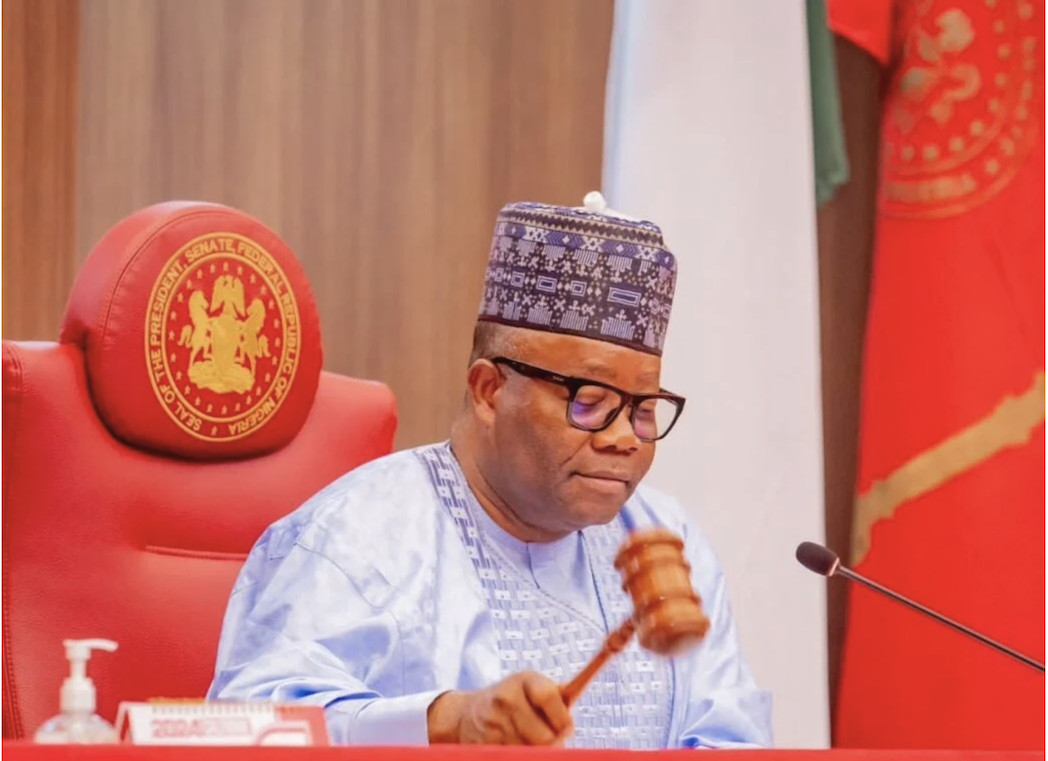
Senator Godswill Akpabio( Senate President), said that federal lawmakers will integrate campaign while doing their jobs.
Senate President, Senator Godswill Akpabio, insists federal lawmakers will combine campaigns with parliamentary duties. Constitutional review, electoral reforms, state police, women’s representation and legislative backlog await September, 2026 resumption. Sunday Aborisade examines the issues at stake.
As the country prepares ahead of the 2027 general elections, the 10th National Assembly is approaching perhaps the most delicate phase of its tenure, a period in which lawmakers will be required to perform a difficult balancing act between the demands of re-election and the constitutional responsibilities for which they were elected.
President of the Senate, Godswill Akpabio, has attempted to settle concerns over the possible and foreseen conflict between politics and parliamentary business, while assuring Nigerians that preparations for the 2027 elections will not derail the legislative calendar or diminish the commitment of
lawmakers to their constitutional duties.
He argued that: The National Assembly will not shut down because politicians have begun campaigning.
Akpabio, while speaking with newsmen at the Presidential Wing of the Victor Attah International Airport, Uyo, Akwa Ibom State, after attending a meeting of All Progressives Congress stakeholders in Akwa Ibom North-West Senatorial District, at the weekend said, lawmakers were elected for four-year term and they must work throughout the period for which they were elected.
In his words, the Senate President said: “We are elected for four years and we are going to work for four years. Anybody that is walking on the tiny rope must be able to do the balancing act”.
For the Senate President, the solution is relatively straightforward. Legislative duties can be performed during parliamentary hours, while personal political engagements can be organized around those hours.
He further said that “We are politicians and campaigns would start very soon. Campaigns can be fixed in the afternoons or evenings while we do our work in the mornings,”.
The assurance comes at a critical moment for the 10th National Assembly. The lawmakers are scheduled to return from their long annual recess in September, 2026 with a legislative portfolio that is more demanding than at any other point in the life of the current Assembly.
The challenge before the Senate and the House of Representatives is not whether they can sit while campaigns are going on. It is whether they can maintain the quality, intensity and consistency of legislative work while many of their members are at the same time, fighting to retain their seats, secure party nominations or pursue an entirely new political ambition.
The September resumption could become a test of the strength and capacity of the 10th National Assembly to separate governance from electoral politics.
The Senate president, Akpabio, is confident that it can be achieved.
He said that “It is not everybody that will go for campaign at the same time because we belong to different political parties. He insisted that nothing will affect legislation.
“We will continue to make laws to take care of the needs of the people. It has never affected the work of the parliament” he said.
That position is politically important because the approaching elections will certainly change the priorities and calculations of lawmakers.
Some senators and members of the House will seek re-election. Others may contest governorships, or return to state politics or seek other elective positions. Political parties will also be preoccupied with primaries, alliances, mobilisation, campaigns and the search for competent candidates for their parties.
It is therefore expected that, parliamentary attendance, committee meetings, public hearings and plenary debates could face increasing competition from political engagements.
However, the legislative agenda awaiting the lawmakers in September leaves little room for distraction.
One of the most important assignments is the ongoing review of the 1999 Constitution.
The review has generated proposals touching virtually every major aspect of Nigeria’s political and administrative structure, including devolution of powers, state creation, electoral reforms, judicial reforms, state police, local government administration and gender representation.
The constitutional alteration exercise has the possibility of leaving one of the most enduring legacies of the 10th National Assembly. Consequently, it also requires painstaking deliberation, consultation and, in many cases, approval by the required number of state Houses of Assembly.
That makes the timetable more delicate.
Among the most politically sensitive proposals is the establishment of state police.
Supporters argue that Nigeria’s centralised policing structure has become insufficient for a country confronting complex and horrible security challenges. They contend that state police could improve intelligence gathering, shorten response times and provide security agencies with a better understanding of local differences.
Opponents, however, remain worried about the possibility of governors turning state-controlled police formations into instruments of political intimidation and brutality.
The debate, therefore, goes beyond whether state police should be established or not. The more difficult question is what constitutional and institutional safeguards should accompany it.
For the National Assembly, this is precisely the kind of issue that demands sufficient parliamentary time. It is the issue most likely to come under pressure as the 2027 political calendar accelerates.
The proposed constitutional intervention on women’s representation is another potential landmark issue.
The Reserved Seats for Women Bill seeks to create additional legislative seats to be contested exclusively by women, with proposals for both the National Assembly and State Houses of Assembly.
The above proposal has attracted strong support from women’s groups and development partners, who argue that Nigeria’s level of female representation remains too low to reflect the country’s composition.
But the proposal is also politically sensitive because it involves altering the structure of legislative representation.
If the proposal secure approval from both chambers, it would still have to pass the constitutionally prescribed threshold among state Houses of Assembly before becoming law. That process alone could consume considerable political energy and time.
There are several other constitutional proposals, making the September-to-2027 window increasingly urgent as well as important.
Ironically, the election that threatens to consume legislative attention is itself dependent on laws that the National Assembly is responsible for making and yet to refine.
What's Your Reaction?
Like
0
Dislike
0
Love
0
Funny
0
Wow
0
Sad
0
Angry
0
Comments (0)